Robotic Friction Stir Welding System with 7th Axis
I. Introduction
Friction stir welding(FSW), as a new solid-state bonding technology, has irreplaceable advantages in non-ferrous metal joining and has been widely applied in industries such as new energy vehicles, rail transit, and power electronics in recent years. The equipment for FSW mainly included gantry friction stir welding equipment, specialized friction stir welding machine, and robotic friction stir welding equipment. At present, gantry friction stir welding equipment is widely used in China for simple two-dimensional straight and curved welding of lightweight alloys. Compared with specialized friction stir welding equipment, robotic friction stir welding equipment can improve the welding automation and production efficiency, solve the problem of batch manufacturing of complex structural products at a lower cost.
II. Components of Robotic FSW System
The basic components of a robotic friction stir welding system generally include:
1. The robot body and its control system, including the robot body, robot control cabinet, operate panel, FSW software package and etc. The robot body and its control system, as the motion device of the system carries the physical operation functions such as welding process force, posture and movement. Due to that FSW is a contact welding process, the robot body needs to have high load capacity and rigidity.
2. FSW spindle and its control system, including spindle body, force sensor, spindle control system and etc. The FSW spindle, as the end effector of the system, is mainly used to drive the rotation of the welding tool. Due to the limitation of the structure of robots, electric spindle is generally used for FSW, and force sensors are equipped to collect force data during the welding process. This design makes the robotic FSW spindle highly compact, greatly improving the maintenance efficiency. The spindle control system is mainly used for spindle drive, clamping and releasing the welding tool, cooling and etc. At the same time, it is responsible for transmitting the collected data to the robot for real-time control.
3. Auxiliary devices and accessories, including welding fixtures, safety protection facilities, loading and unloading auxiliary devices and etc. According to the different welding process requirements, linear units, welding positioners and etc.could also be equipped.
III. Development and Achievement for Robotic FSW System of WWW
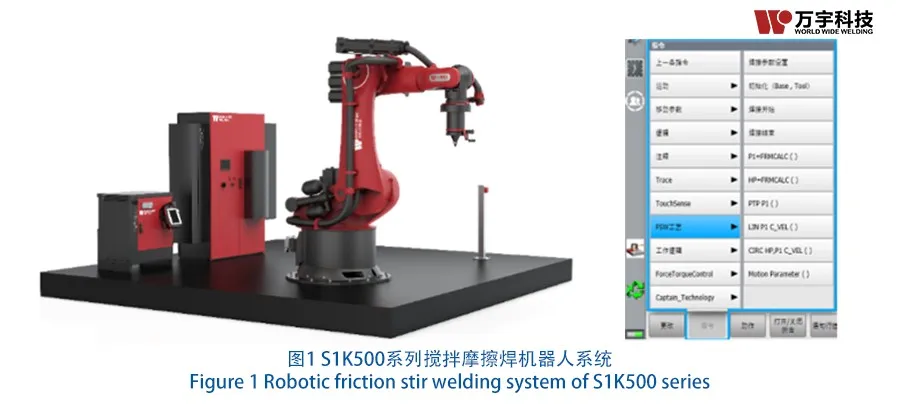
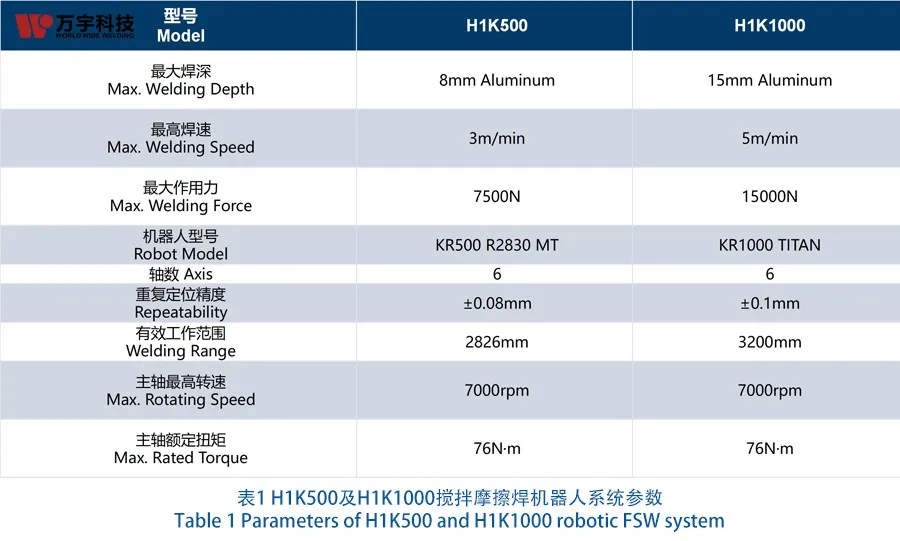
Since 2017, World Wide Welding has researched on robotic FSW system, developed a specialized control system for flexible welding robots to achieve integrated control and led the development of the group standard TCWAN 0105-2024 "General technical specifications of robotic friction stir welding system". Currently, we have formed multiple series of robotic FSW products such as H1K500, H1K1000, M1K500, and S1K500. The equipment has high-performance force sensors and advanced force control system, which can achieve force control up to 250Hz, enabling more efficient welding and more stable process control. Currently, the robotic system has a maximum welding speed of 5m/min.
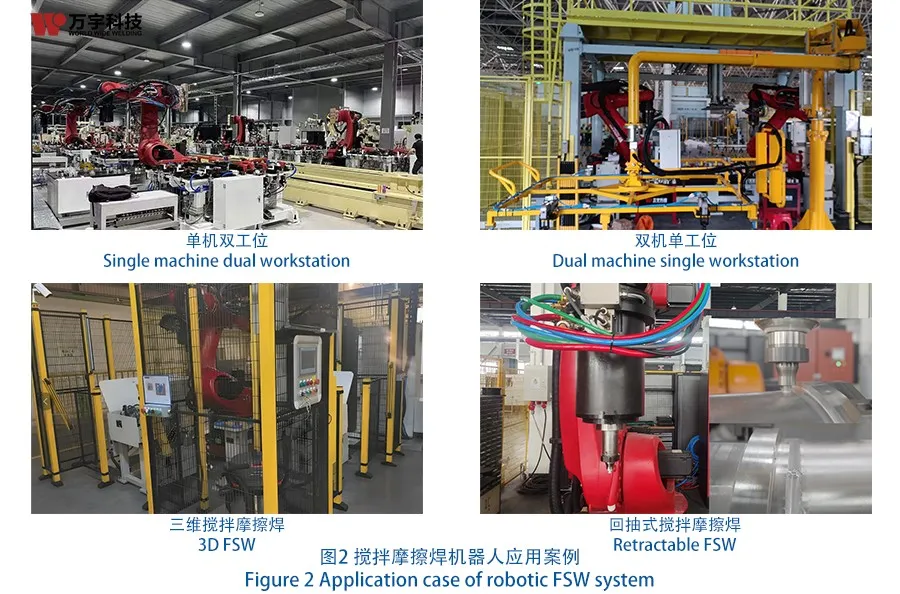
World Wide Welding has also developed a stationary shoulder robotic FSW process, which has high efficiency, high performance, and good forming, in order to better leverage the advantages of robotic FSW in applications. After years of development and application, WWW has obtained more than 20 authorized invention patents in stationary shoulder FSW , led the development of the group standard T/CWAN 0022-2021 " Specification for design and manufacture of FSW stationary shoulder welding tool ", and also has formed a complete set of robotic FSW process packages to help users better apply this system. FSW robots have multiple degrees of freedom and significant advantages in welding complex three-dimensional structures. World Wide Welding has currently undertaken multiple mass production projects for three-dimensional FSW and has rich experience in structural design, welding tool design, path planning, and process design for three-dimensional structure welding. In addition, WWW has successfully developed a retractable FSW spindle which can be mounted on robots, achieving the elimination of keyhole after FSW,which will have more applications in aluminum wheels, semiconductor target materials, aerospace and other fields in the future.
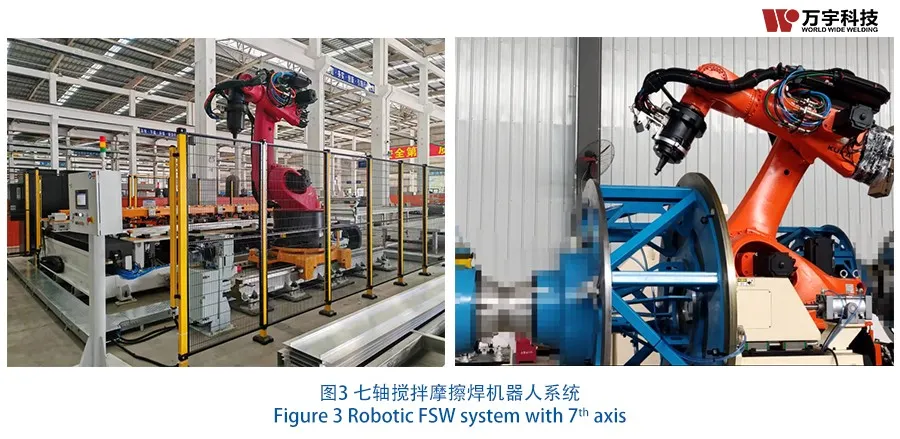
World Wide Welding has developed a seventh axis system suitable for FSW based on standard robotic FSW system modules. It has the characteristics of high load, high rigidity, high torque, and high positioning accuracy. It can achieve linkage and motion coupling with the robot body, with precise trajectory, and can greatly expand the working range of the robotic FSW system. This system can achieve a maximum welding speed of 2000mm/min (for 2mm aluminum) and a maximum welding depth of 6mm aluminum alloy. At present, the system has been applied in fields such as aerospace and construction. Compared to traditional large range gantry welding equipment, robotic FSW system with seventh axis has advantages such as low cost and strong scalability.
In the future, World Wide Welding will continue to research and develop robotic FSW system in terms of rigidity improvement, efficiency enhancement and intelligence. We will continue to provide users with rich product choice and high quality service.


评论
发表评论